Hygrometer
The hygrometer is an instrument used to measure humidity in many things, not only in the atmosphere. It can measure the humidity in soil and confined spaces. Sometimes the
instruments that measure the humidity depend on the others measurement, such as pressure, temperature, mass or mechanical or electrical change in the properties that can effect humidity (Wikipedia, 2018). This means, that hygrometers can be used indirectly by calculating and calibrating the pressure and temperature changes which help us to measure the humidity in the air.
 There are many types of hygrometers, such as electrical hygrometer, psychrometers and dew point hygrometer (Switches, n.d.).There are many types of moisture measurements, but we will discuss three types: electrical hygrometer, psychrometer and dew point hygrometer. Firstly, electrical hygrometers measure the amount of moisture by calculating the resistance and capacity applied to the device. The electric humidity meter is divided into two parts: resistance and capacity hygrometer.
The first part measures the humidity by the electricity that passes inside a
piece of ceramic substance. The second part has two metal sheets, and air passes through them so the humidity is measured.
The second type is psychrometer. This type contains two thermometers: one with a dry bulb and the other one with wet bulb. The different readings
between the dry and wet bulbs to determine the air humidity. Another type is the dew point
hygrometer. This type works by measuring the saturation of moist air of gas. This device is the more accurate than all of the hygrometers (Switches, n.d.).
Refrenceses:
Hygrometer. (2018, September 15). Retrieved from https://en.wikipedia.org/wiki/Hygrometer
(n.d.).
Retrieved from http://www.switches.co.za/different-types-hygrometers-uses/
photo from: https://en.wikipedia.org/wiki/Hygrometer
Ali Alnaqbi
Meteorology Student
Anemometer
Wind is everywhere around us, so in the past our ancestors were measuring the
wind direction using weather vanes which consisted several sticks that moved
when the wind blew. After many years people invented the cup anemometer
which consisted of four cups that rotated at the same speed of the wind.
An anemometer is an instrument used to measure the speed of air in the
atmosphere. Also, meteorologists can use the anemometer in weather stations,
which must be 10 meters above the ground.
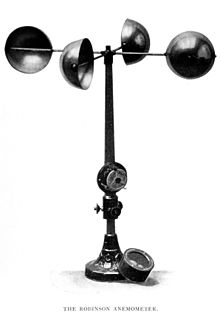
The word anemometer comes from the Greek word (anemos) which means wind. In 1450, Leon Battista
Alberti invented the first anemometer. In addition, people around the world developed the ancient anemometer into several modern types, such as the helicoid propeller anemometer, the hand-held digital anemometer, the hot
wire anemometer, the laser doppler anemometer, the ultrasonic anemometer, the acoustic resonance anemometer, and the ping pong ball anemometer
(Britannica, 2013).
Furthermore, in the case there is an absence of instruments, the wind direction
can be figured out using various methods, such as the movement of smoke, a
flag’s direction, and the movement of the leaves. Because of an absence of an
anemometer, meteorologists can use the Beaufort scale to guess the wind’s
speed. If smoke rises vertically, the wind speed will be below 1 knot. Also if the
wind is felt on the face and an ordinary vane moved by the wind, then we call it
a light breeze with a speed between 4-6 knots (Khaild,2005).
image: https://en.wikipedia.org/wiki/Anemometer
Amina Almarzooqi
Meteorology Student
Psychrometer
A psychrometer is an instrument measures the relative humidity in the atmosphere by using two thermometers which are “ dry bulb and wet bulb”. A dry bulb thermometer
is used to measure the temperature by being exposed to the air and the wet bulb thermometer measures temperature by having the bulb dipped in a liquid.

There are three types of psychrometers: ( sling psychrometer , assmann aspirated psychrometer, and psychrometer by august ). A Sling Psychrometer is used to
measure both the dry bulb and wet bulb temperatures. These temperatures are a measurement of humidity content in the air. The second type is the Assmann aspirated
psychrometer it has two tubes filled with mercury and is mounted vertically side by side in chromium or nickel plated metal frame. They are connected by ducts to an aspirator.
The aspiration may be driven by an electric motor or a spring. This devises is portable.
The last type of called psychrometer is an August, psychrometer, and it’s used for measuring temperature extremes and to determine relative humidity. Dry and wet
bulb reading help us to calculate the actual vapor pressure, dew point temperature and relative humidity.
https://prezi.com/ot4_wlpxeo_x/psychrometer-slingassman-types/
image source: http://www.daviddarling.info/encyclopedia/P/AE_psychrometer.html
Maythaa Almansoori
Meteorology Student
Ceilometer
The ceilometer is a modern instrument used in meteorology stations. The device has
optical beams to measure a cloud’s celling and overall cloud thicknesses. One important
use of the ceilometer is to determine cloud ceilings at airports. Also it is used to measure
aerosol concentrations within the atmosphere.
So how it does work? Ceilometers send laser or light to the sky, (often produced by an
infrared or ultraviolet transmitter or a laser) and when the base of the cloud is observed
some of the light bounces back the beams then reflected to the device and detected by a
photocell in the receiver of the ceilometer.
There are two types of ceilometers which are scanning receiver and rotating transmitter.
The scanning-receiver ceilometer has a separate light transmitter fixed to direct its beam
vertically. The parabolic collector of the receiver scans up and down the vertical beam,
searching for the point where the light touches a cloud base. When a reflection is
detected, the ceilometer measures the vertical angle. A simple calculation then yields the
height of the cloud ceiling. Many modern scanning-receiver ceilometers used a laser pulse
to identify the height of a cloud’s base, the top, and various points in between to create a
vertical profile of the cloud.
The rotating-transmitter ceilometer has a separate receiver fixed to direct reflections only
from directly overhead while the transmitter sweeps the sky. When the modulated beam
touches a cloud base directly over the receiver, light is reflected downward and detected.
“John P. Rafferty Jun 15, 2012”.
Marwan Alkthairi
Meteorology Student
 AD Poly's Weather Blog